Army of the Sun
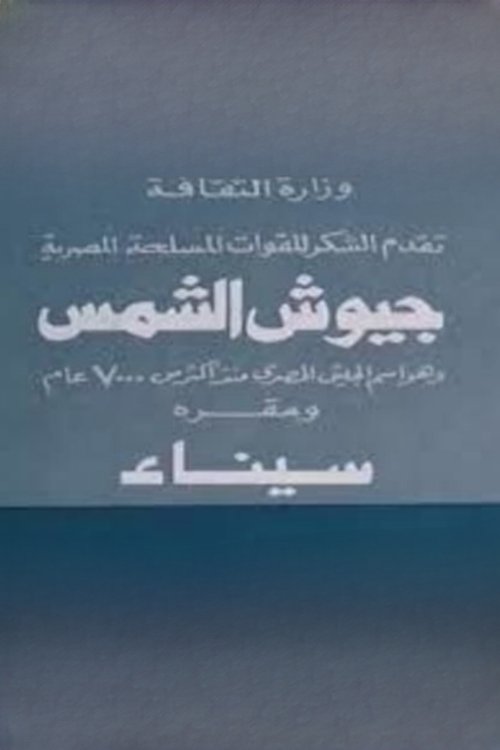
This documentary tries to capture the fresh sense of triumph in the eyes of the Egyptian soldiers after the 1973 war with Israel.
Canonical catalog
1000 titles

This documentary tries to capture the fresh sense of triumph in the eyes of the Egyptian soldiers after the 1973 war with Israel.

In the final days of the Pacific War, two Japanese soldiers, a senior officer and a local recruit, are cornered during the battle of Okinawa and hide in a banyan tree, only coming down for food. Unaware the war has ended, the two await reinforcements for two years. As they wait, they discover differences in rank, worldviews and motivation.

September 1944. The Battle of Arnhem was one of the most audacious but ultimately controversial battles of the Second World War. Airborne drops in Holland were to secure important bridges on the route to be taken by ground forces racing to gain a foothold across the Rhine. Had it succeeded it might have ended the war by Christmas 1944.
The Battle of Arnhem, fought in the early autumn of 1944, remains without a doubt the most hotly debated battle of the North West European Campaign, both then and now. From its inception in the sixteen cancelled airborne operations during August, we will chart the problems, many of which were ignored by men desperate to get into battle, the compromises and mistakes that pitched lightly armed and ill equipped paratroopers and glider infantry into an unequal struggle against an SS panzer troops. We follow the eight mile route that 2 Para took to reach the bridge at Arnhem, slipping through the German defences.In Part 2, a separate film we look at their epic battle.

Graeme Warrack was Divisional Chief Doctor of the 1st Airborne Division at the Battle of Arnhem in September 1944. With other doctors, medical personnel and padres, he stayed behind with the wounded. The first improvised hospital was a German-occupied Dutch military barracks at Apeldoorn. From here, the wounded were transported to prisoner of war camps in Germany. As the last of the wounded left, Colonel Warrack escaped.

The original short which inspired the film Son of Rambow

The story of political prisoners, detained in a jail before the start of the WWII, and their torture and attempts to escape, and join a partisan unit.

A soldier returns to Kyiv after surviving a train crash and encounters clashes between nationalists and collectivists. The story of the suppression of the Bolshevik uprising at the Arsenal factory in Kyiv by the Central Council troops.

Manipulating a variety of sources, Vasulka uses creative imaging tools to situate historical images against Southwestern landscapes of incredible beauty. Contorting the images into a variety of isomorphic forms, Vasulka creates a literal shape for these memories, developing these shapes as metaphors for the processes of fragmentation, condensation, and inversion, that inevitably contort fact into memory. While much of the raw material for the tape is drawn from World War II and its rehearsals, the Spanish Civil War and the Russian Revolution, The Art of Memory is really an extended meditation seeking to reconcile the blurry, banal photographs of historic figures with the mass destruction they helped engineer.

Jonas (Saeed Aghakhani), a former Iranian soldier during the Iran-Iraq War, sets out to search for his fallen brother's bodies years after they were killed in action.

The German soldier Clemens Forel - determined to be reunited with his beloved family - makes a dramatic escape through bitter cold winters, desolate landscapes, and life threatening ventures from a Siberian labor camp after World War II. 8000 miles and three endless years of uncertainty later, he is finally about to reach his destination... An edge of your seat drama that celebrates the power of the human spirit and the force of will, while inspired and impowered by love.

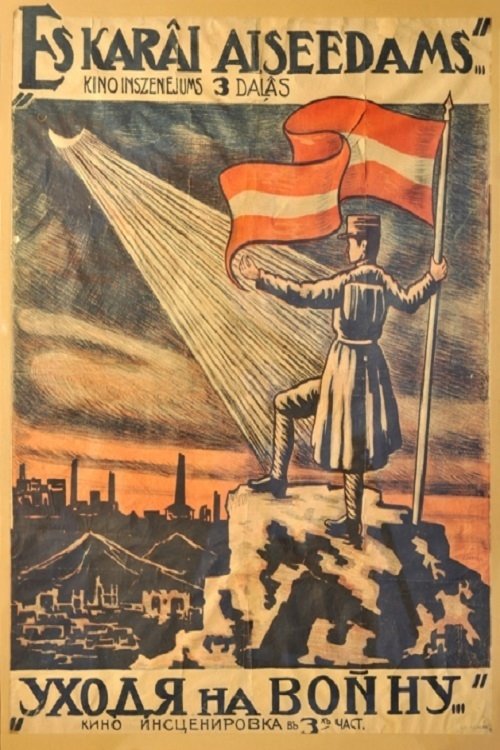
The film is a family drama set against the backdrop of the First World War and Latvia's freedom struggle.

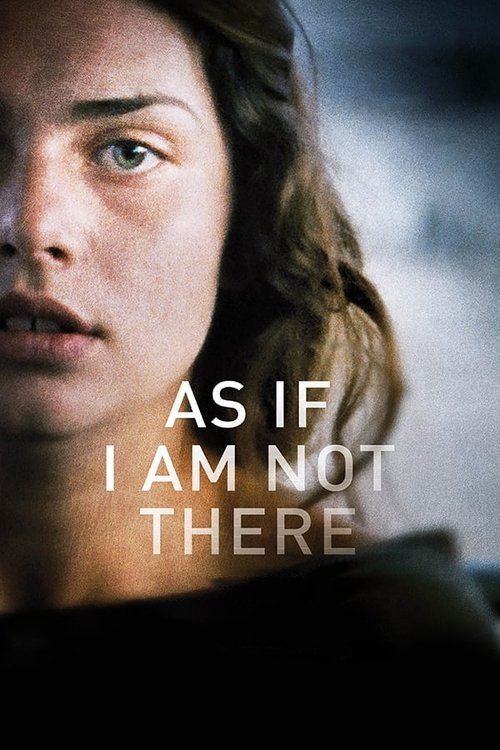
A harsh dose of cinematic realism about a harsh time – the Bosnian War of the 1990s – Juanita Wilson's drama is taken from true stories revealed during the International Criminal Tribunal in The Hague. Samira is a modern schoolteacher in Sarajevo who takes a job in a small country village just as the war is beginning to ramp up. When Serbian soldiers overrun the village, shoot the men and keep the women as laborers (the older ones) and sex objects (the younger ones), Samira is subjected to the basest form of treatment imaginable.

A man comes back from war full of grief and deep-rooted anger at the system that placed him there.

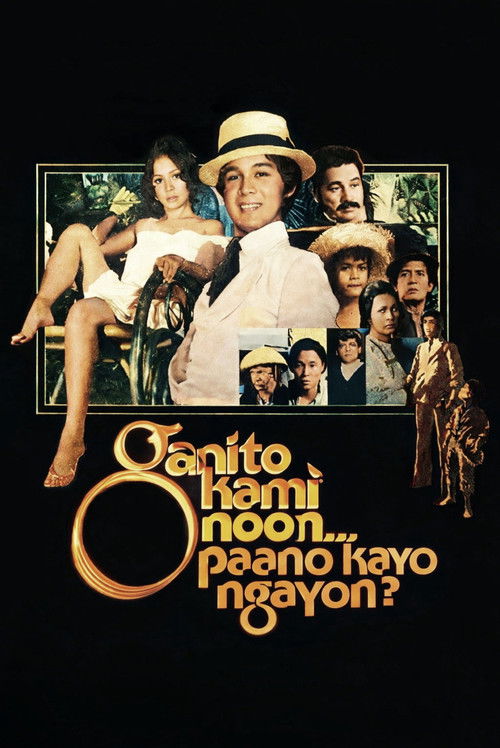
Set at the turn of the 20th century during the Filipino revolution against the Spaniards and, later, the American colonizers, it follows a naive peasant through his leap of faith to become a member of an imagined community.

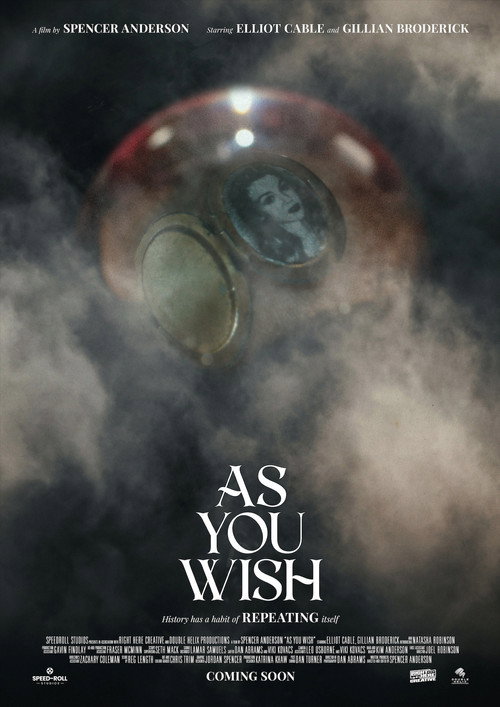
In the wake of WW2, a soldier is granted a wish by a fortune teller.

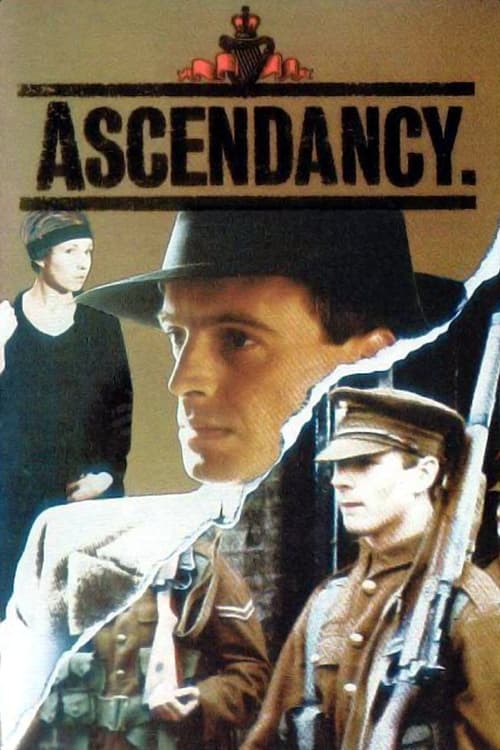
Ascendancy is a 1983 British film. It tells the story of a woman who is a member of the British landowning 'Ascendancy' in Ireland during World War I. Gradually, she learns about the Irish independence movement, and becomes involved with it.

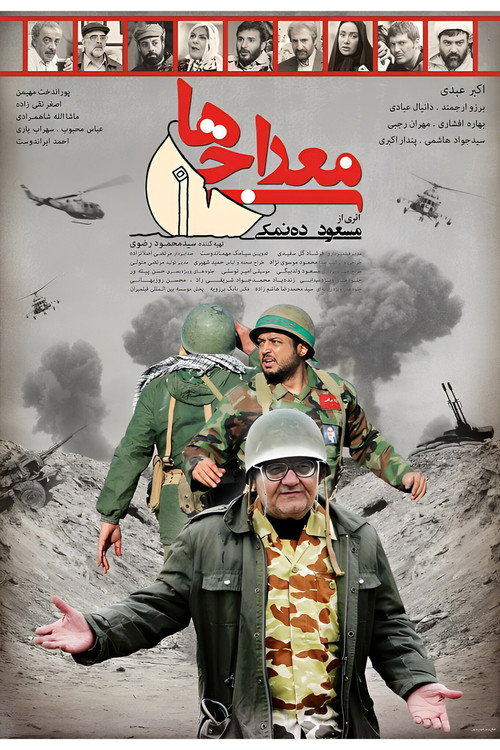
Mohammad a young man is eager to go participate in war but his father is strongly refusing and makes alibis not to let him go. But one night Mohammad escapes from the home and goes there. Now the father has to go to the front lines of war to find his son.
Ascent of Evil: The Story of Mein Kampf is an autobiographical manifesto written by Nazi Party leader Adolf Hitler while imprisoned following his 1923 failed coup attempt in Munich. In Mein Kampf, Hitler outlined his political ideology and goals for Germany. Today, Mein Kampf is still available in libraries, on the Internet, at universities and even at bookstores worldwide. Yet much of the history of this 720-page, two-volume screed is now forgotten. Using historical footage, photographs and interviews with scholars, Ascent of Evil plunges deep into the infamous blueprint for evil’s dark secrets and reveals how this book came to be written and its impact on world.

They were young, their life was in bloom and their hearts were longing to love.

ASHCAN is a theatrical docu-fiction. It tells the story of the secret prison where the main Nazi leaders were incarcerated following the Allied victory on May 8, 1945 under U.S. authority at Mondorf-les-Bains, Luxembourg.

On the eve of the Second World War about one hundred fifty Italians aircrafts bombarded the northern part of Ethiopia with poisonous gas. On March the 6th 1936 the town of Ashenge was shocked by an atrocious mass murder which changed the life of Kassa forever. During the Italian occupation, the Ethiopian patriots fought to restore people’s freedom but few Ethiopians collaborated with the enemy, creating seemingly insurmountable challenges to the freedom fight. To overcome these years of agony, Serke must deal face-to-face with the man responsible for heinous killing of both her parents.

A young academy soldier, Maciek Chelmicki, is ordered to shoot the secretary of the KW PPR. A coincidence causes him to kill someone else. Meeting face to face with his victim, he gets a shock. He faces the necessity of repeating the assassination. He meets Krystyna, a girl working as a barmaid in the restaurant of the "Monopol" hotel. His affection for her makes him even more aware of the senselessness of killing at the end of the war. Loyalty to the oath he took, and thus the obligation to obey the order, tips the scales.