
movie· 1969· Finished Airing
G-senjou no Higeki
mal
Avant GardeComedy
Short experimental animation from Yoji Kuri.
Provider ★ 3.7·0 tracking
Canonical catalog
1000 titles
Short experimental animation from Yoji Kuri.

In this story, the kids are constantly forced to bury themselves into their endless homework by those giant monsters behind them. The children's brains are filled with water that can be heated by tension. If a kid is overstressed, the water in their brain would boil and produce steam, which becomes the food of the greedy monsters and the energy of the whole city. Thus, those poor children repeat their lives day after day, serving as the powerplant of their world, spending their childhood in tragic misery...

A horror spin on the classic tale of "The Little Match Girl".

Abstract animation by Keiichi Tanaami and Nobuhiro Aihara.

The story of Adam and Eve with jazzy music. Short experimental animation without words.

A Parade for three managers and four performers. (Source: Yamamura Animation)

An animation mixing hand-drawn and cut-out techniques depicting the daily rituals of weekday morning that is occasionally interrupted by flights of fantasy delivered in stroboscopic flashes. Showing scenes of brushing teeth and face washing, Tanaami describes the film to be like a self-portrait on his favorite day of the week. (Source: Collaborative Cataloging Japan)

Music video by Kousuke Sugimoto for the title track Alice In Voodooland by RoughSketch and featuring Aikapin.

Gestalt was shot over the course of a year in a Tokyo dormitory. Each day, Ishida would paint on the wall and photograph it using the available light from the window. The 7-minute long film, which is accompanied by haunting organ music composed by J.S. Bach, consists of those several seconds of film Ishida shot daily. (Source: Midnight Eye)

People often consume caffeine to improve their mood, but for one salaryman, it is like a rocket ship blasting him off—away from the monotony of his desk to a world full of color, inspiration, and life. [Written by MAL Rewrite]
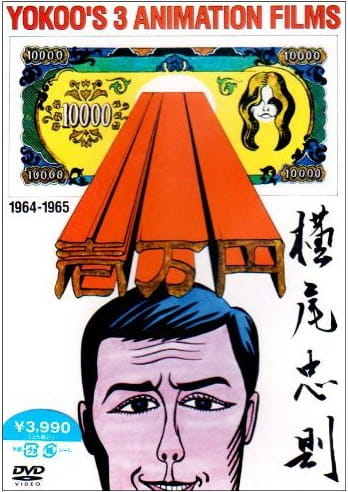
Three short films by the Japanese avant-garde illustrator and animator. Regarded (unfairly) as the Japanese equivalent of Andy Warhol, these films showcase a distinctively commercial illustration look reminiscent of the current pop art movement of that decade (1960s).

An experimental film by mareykrap about the color blue. Blue pigment in the natural world is very rare. Instead, what we typically observe is the reflection of blue light waves. How much "true blue" really exists in our world? A series of blue images. Or are they?

Short animation by Sawako Kabuki.

In Crayon Angel, Tanaami recalls his childhood memories of wartime Japan during the Second World War. The animation mixes wartime footage, family photographs and pop imagery, much of which is seen through fusuma-like grids that cut apart the image and distance it from the viewer. The soundtrack includes a haunting heartbeat, sounds of sirens and Robert Plant’s moans. The title refers to a campaign ran during the war by a confectionary company that asked children to submit crayon drawings of their brand icon, an angel, which had a profound emotional impact on Tanaami as a child. (Source: Collaborative Cataloging Japan)

Backed by an ode John Lennon penned himself, the relationship between him and his wife, Yoko Ono, is beautifully depicted. Alongside their romance, '60s-appropriate psychedelic imagery and various allusions to Lennon's contributions to the Beatles are interlaced within. [Written by MAL Rewrite]

Some say that Japanese drum bridges serve as a channel between two worlds—the living realm and the afterlife. To answer the ancient question of what exactly transpires at the eternal crossing point, psychedelic twists and abstract visuals explore the legendary chaos that ensues at the enigmatic border between the mundane and the divine. [Written by MAL Rewrite]

The human eye, a well-known motif in psychedelic culture, is duplicated and intensified in this cinematic trip. Drawing from his experiences designing discotheques, Tanaami presents two prints of the same film in double projection with a time delay ––one projected a few seconds earlier than the other–– to suggest the mind slipping out of consciousness. (Source: Collaborative Cataloging Japan)

Everything is liquid in this world, like the mayonnaise. (Source: Official website)

Set in a cave imagined as an air-raid shelter, images of the surrounding trees are painted over directly on the film. Vivid colors intermixed with the sound of wartime radio communications and bombing create a harmonious composition of documentary and animation. (Source: Collaborative Cataloging Japan)

An animated bumper from MTV Japan.

How long has it been since she lost control of her body? She is completely tapped out and finds herself wishing that she could just shed her body. (Source: Geidai Animation)

Short film by Atsushi Wada about Spring.

A Place Where There Are Moths depicts the conflict between drab concrete block apartment living and the natural environment in Japanese cities. The forces of nature are represented by the motif of a tree whose leaves metamorphose into orange moths and take over a middle-aged woman's apartment, pushing her room higher and higher within the building. (Source: Midnight Eye)

Film by Takashi Ito.